|
|
|
             Sitemap |
Making sense of
|
|||||||||||||||||
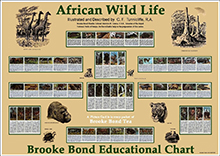
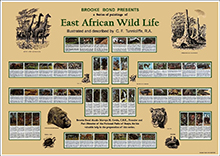
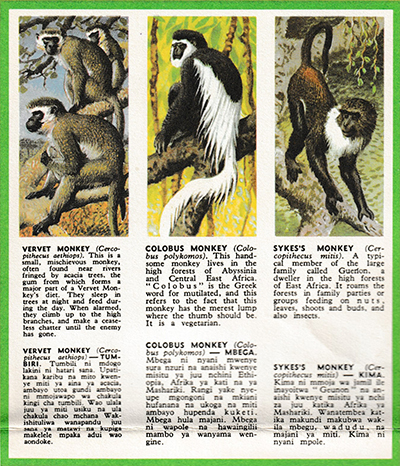
Elsewhere, Williams project had attracted the attention of Mervyn H. Cowie who, as Founder and Director of the Royal National Parks of Kenya and Vice-President of the East African Tourist Travel Association, had been equally keen to promote interest in that country's wild life. He worked tirelessly to set up national parks throughout East Africa in the 1950s, and hounded the Kenyan Parliament to support the project. As a result, he was often - somewhat caustically - referred to as 'the member for wild animals2. Cowie arranged for thousands of African children to visit the Nairobi park and, in 1961, welcomed the distribution of Brooke Bond's green backed African Wild Life, together with album and wallchart [see below], to the country's schools as a valuable educational aid. Like Williams, he sought to promote home and overseas tourism as a means to put Kenyan national parks on the world map, and provide the funds for the protection and conservation of the country's wildlife. Consequently, a third East African chart - featuring a 'series of [50] paintings' by Tunnicliffe and titled East African Wild Life [see below]- has been commonly associated with the publication of the aforementioned 50 card African Wild Life series3. However, the chart refers to the 'valuable help' of Mervyn H. Cowie as 'Past Director of the National Parks of Kenya' (my italics), and since he did not relinquish that post until five years later cannot have been published before 1966. In fact, further dating evidence suggests that East African Wild Life was produced alongside its companion charts in 1969 (East African Wild Life and East African Birds) and 1970 (East African Birds, Series 2)4. Tunnicliffe replaced at least eleven of the subjects of the original series with new or amended paintings5 - presumably to better suit the chart's more narrow focus on 'East African', rather than the broader range of 'African' wildlife6 - and the descriptive text was presented in both English and Swahili (widely spoken in Kenya, Tanganyika and Uganda, all countries with recently established national parks and in which Brooke Bond was active). Whatever, the distribution of all three East African charts in Rhodesia is unlikely, since it was reported at the time that the company was only able to issue 'old stocks' of cards and associated material 'due to no further supplies being available because of the sanctions imposed on the country' following Ian Smith's unilateral declaration of independence of November 19657.
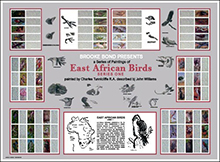
Given the determination of John Williams and Mervyn Cowie to put Kenya's national parks on the 'world map', it is highly likely that the East African Birds and East African Wild Life charts were intended to support the project, and were issued to coincide with or follow the publication of Williams' seminal Field Guide to the National Parks of East Africa in 1967/68, depicting the 'mammals and rarer birds of the area'. Certainly, the invitational style of the wording on the former two charts suggests that distribution was limited to institutions such as the national parks of East Africa:
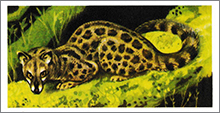
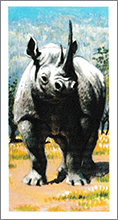
Such limited distribution would explain the scarcity of these charts today (remaining stocks were sold by Brooke Bond in the UK in 1973/749 - for the grand sum of 25p each - but were soon exhausted and there was no reprint). It's worth noting here that one avid Brooke Bond collector recalls that the East African Wild Life 'poster' was on prominent display at 'Treetops', situated on the edge of the Aberdare National Park in Kenya. Here, he was 'pleased to see how much attention' the bi-lingual English and Swahili chart attracted, with 'small groups of tourists constantly gathered around...checking which animals they had seen', and notes that 'of the 19 larger animals regularly spotted at Treetops, only one, the African Hare, was not shown' on the chart. During his short stay at Treetops, the writer records seeing thirteen of the animals depicted on the chart, including the Genet and Rhinoceros (pictured, below). In a second game park, Nairobi National Park, the same observer remembers that two East African Birds 'series one and two' were also presented as a guide to tourists, as was 'a poster entitled African Wild Life...which had text only in English', and had originally served as an 'educational aid' to the city's schoolchildren10.
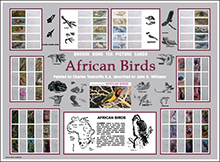
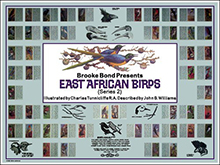
It seems likely, therefore, that the East African Birds and East African Wild Life wallcharts represent no more or less than a distinct collection of 150 paintings and textual descriptions by the renowned naturalists Charles Tunnicliffe and John Williams, 'presented' by Brooke Bond, produced with the 'valuable help' of Mervyn Cowie, and published in 1969/70. As such, they were not necessarily related directly to the publication of any earlier set of picture cards, and there appears to be no conclusive evidence to suggest that the company intended to issue further sets based on their content. In other words (and to coin a phrase), they did exactly what it said on the tin – presented 'a series of paintings' displayed on three equally impressive and exquisite wallcharts.
Article and pictures courtesy of Vaughan Wells
- July 2024 |
||||||||||||||||
|
|