|
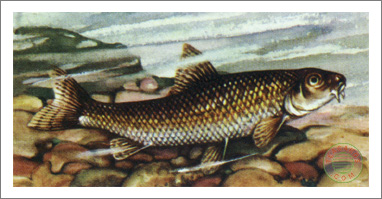
This small fish is abundant in England, except in the Lake District and in Cornwall, especially over the gravelly stretches of rivers. It keeps to the bottom, grubbing for insect larvae, worms and small shellfish. The body is dark, with a longitudinal row of squarish blue-black blotches on each side. The tail is forked, the scales rather large. It can be distinguished from similar fish because it has only two barbels. The largest specimen caught by angling* weighed 4½ oz.
*up to 1958. |